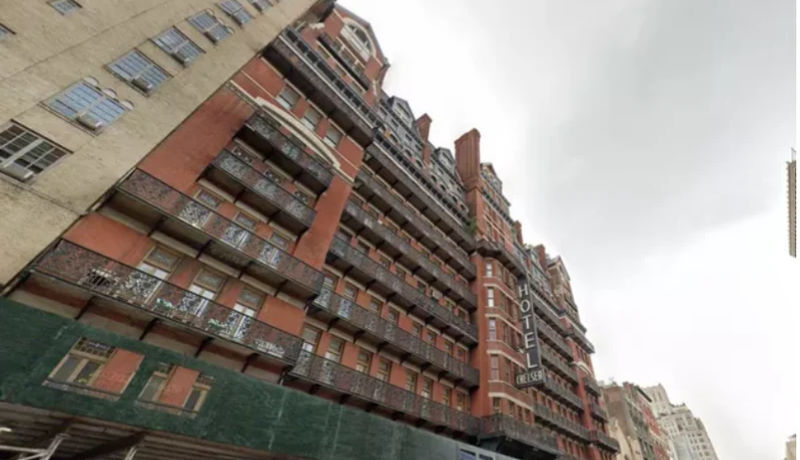
Photo by Karen Kostiw
Chelsea Now: The Next Chapter
One reason I keep finding Chelsea so fascinating is that the neighborhood never seems to settle into a final version of itself. Just when you think its identity has become fixed, another transformation begins.
Consider the building atop this page. The Hotel Chelsea, the home of Mark Twain, Janis Joplin, and Madonna over the years, closed in 2011 and spent more than a decade dark as its restoration worked through disputes, delays, and changes of ownership. It reopened in 2022 as a luxury hotel, its famous lobby restored, the legendary El Quijote back in business, and a few dozen long-term residents still in place. No building in the neighborhood better embodies the idea that a landmark’s history is its foundation, not its limitation.
For much of the past three decades, the conversation centered on galleries, adaptive reuse, the High Line, and the extraordinary reinvention of Manhattan’s West Side. Today, a different pattern is emerging. The neighborhood’s next chapter appears increasingly influenced by hospitality, wellness, community, and the creative reuse of existing structures.
Reimagining Historic Spaces
Few examples illustrate this better than the former Bayview Correctional Facility.
For more than a decade, the building sat vacant, an imposing reminder of a different era. Last month, that changed: the $167 million Chelsea Beacon redevelopment officially broke ground, transforming the former prison into up to 131 permanently affordable homes, including at least 79 supportive units, along with a 15-unit transitional residence and roughly 9,300 square feet of community space. Designed by COOKFOX and developed by Camber Property Group and the Osborne Association, the project is slated for completion in 2029.
The project is notable not just for what it builds, but for what it represents: another example of New York’s remarkable ability to find new purpose in existing places.
A few blocks away, another landmark appears poised for reinvention. The former Limelight building, which has served as a church, nightclub, marketplace, and cultural destination, is expected to become the New York home of London’s Maison Estelle private members’ club—the company’s first U.S. location, with roughly 30,000 square feet leased. That trajectory feels inherently Chelsea. The building’s history isn’t erased. It becomes the foundation for its next incarnation.
The Rise of Hospitality Living
Along the neighborhood’s western edge, One High Line and Faena New York point to yet another evolution.
Increasingly, luxury seems less about ownership and more about experience. Wellness, hospitality, culture, and service now sit alongside architecture and location as defining components of residential value.
Faena New York opened in September 2025 at the base of One High Line, and its offerings keep deepening—most recently with the new 17,000-square-foot Tierra Santa Healing House, one of the city’s largest hotel spas, with more programming still to come. Residential, hotel, cultural, and social environments are becoming increasingly intertwined.
New Residential Chapters
Chelsea’s evolution is also visible in its housing stock — not just in how much has been built, but in how varied it is.
Buildings like The Cortland, The Elisa, Maverick, and One High Line have largely sold out and are now part of the neighborhood’s fabric, while newer conversions and boutique projects, including The Myles, 327 West 22nd, and 534 West 29th, extend the neighborhood’s residential story. Boutique condominiums stand alongside larger mixed-use projects, and historic conversions coexist with bold contemporary architecture. What is striking is not simply the volume, but the diversity.
Chelsea Continues to Change
Viewed separately, these projects tell different stories. Viewed together, they reveal something larger.
Chelsea continues to thrive because it remains open to reinvention. New ideas arrive. New uses emerge. New generations leave their imprint. Yet something remains remarkably consistent beneath the change.
Perhaps Chelsea’s most defining characteristic has never been architecture, development, art, or even location.
It has been its willingness to evolve.
And judging by what is happening today, the next chapter may be just as interesting as the last.
PS
LA CABRA
The newest La Cabra is opening in Chelsea this Friday (10/16). The new flagship cafe and bakery is at Lantern House, and the design is inspired by the High Line right above it.
Chelsea – Lantern House Bakery
515 W 18th St
10011, New York
USA
Opening Soon – Friday October 16th
Monday – Friday:
8AM – 6PM
Saturday – Sunday:
8AM – 6PM